Short answer: A general home inspection is a visual, above-ground survey of 400+ components governed by the InterNACHI and ASHI Standards of Practice. A sewer scope is a video inspection of the buried drain lateral from the home's cleanout to the city main, using a self-leveling push camera and NASSCO PACP defect coding. They overlap by exactly zero square feet. Most Minnesota buyers need both.
The side-by-side comparison
Every row below is taken from the InterNACHI Standards of Practice, NASSCO PACP coding manuals, and our internal data from 5,113+ Minnesota inspections delivered since 2013.
| Dimension | General Home Inspection | Sewer Scope |
|---|---|---|
| What is inspected | Roof, attic, exterior, structure, HVAC, plumbing fixtures, electrical, interior, insulation — above-ground only | The buried sewer lateral from cleanout to city main (typically 40–120 ft in MN) |
| Standards followed | InterNACHI SOP · ASHI SOP | NASSCO PACP defect coding |
| Equipment | Moisture meter, thermal camera, GFCI tester, voltage detector, ladders | 200-ft self-leveling HD push camera, 512 Hz sonde, distance counter, HD recorder |
| Time on site | 2.5–4 hours | 30–60 minutes |
| Deliverable | 40–80 page PDF report with photos, summary, and material defect list | HD video link + 4–8 page report with footage-tagged defects, NASSCO codes, repair-class flags |
| Defect coding | Narrative + photo; no industry-standard taxonomy | NASSCO PACP (RFL, CC, JOM, JSM, DAR, etc.) — recognized by every repair contractor |
| Typical findings (MN) | Roof wear, ice-dam staining, asbestos siding, federal Pacific panels, ungrounded outlets, foundation cracks | Root intrusion at clay joints, Orangeburg deformation, cast-iron channeling, bellies, offsets, partial collapses |
| Typical MN cost | $399–$649 depending on square footage | $189–$279 standalone; $129–$179 as a bundled add-on |
| Inspector credential | InterNACHI CPI or ASHI; CMI® for master-level | NASSCO PACP certified; CMI® preferred |
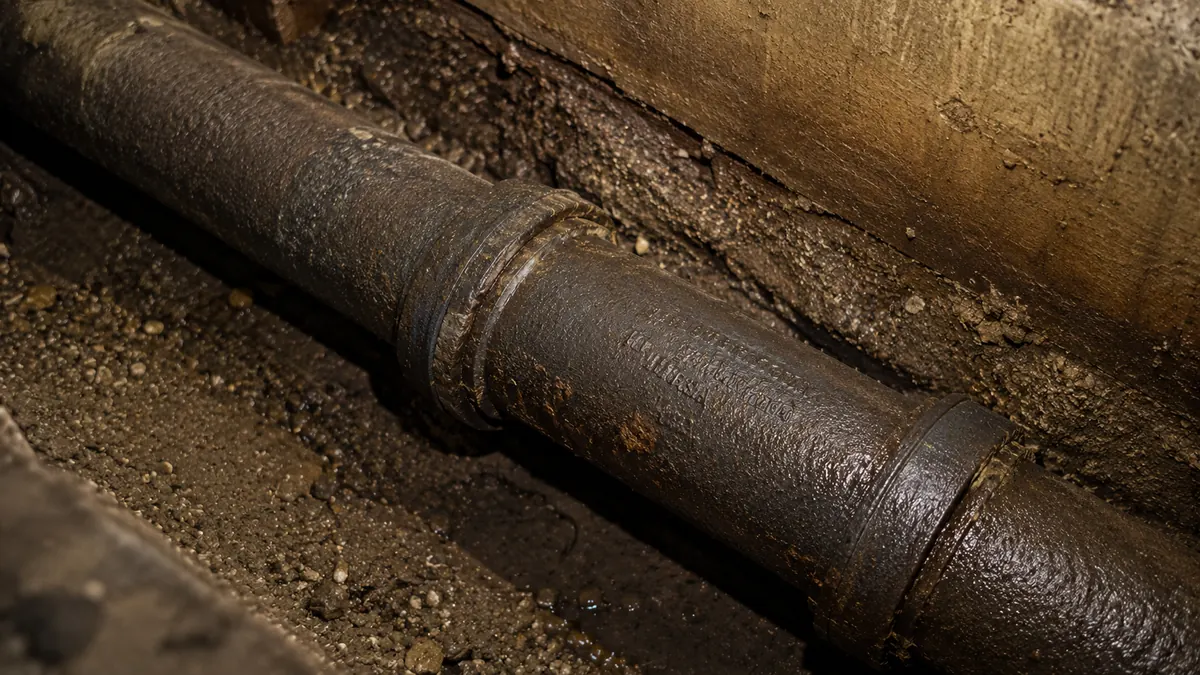
What a general home inspection covers (and where it stops)
A Minnesota general home inspection is governed by the InterNACHI Standards of Practice section 4 (Structural), 5 (Roof), 6 (Plumbing), and 7 (Electrical), among others. The plumbing section explicitly limits the inspector to "readily accessible" components and excludes underground systems, sewer lines, septic systems, and any portion that requires moving fixtures or excavating.
In practice, your general home inspector will:
- Run every fixture and watch the drain rate
- Fill the laundry tub and check for slow drains downstream
- Check water-heater venting and TPR valve condition
- Note the presence of a floor drain and cleanout (or the absence)
- Document visible cast-iron stack corrosion in the basement
That last point is important: a competent inspector in Minneapolis, St. Paul, or Edina will often flag the buried sewer as suspect based on the home's age and visible above-ground clues — but they cannot confirm condition without a camera.
What a sewer scope covers (and what it confirms)
A sewer scope is a single-purpose video survey. The camera enters at the cleanout (or, if absent, through a removed toilet or roof vent), travels the full lateral length, and reaches the city main. Every defect is logged with three pieces of metadata:
- Distance marker — exact footage from the cleanout (e.g., "RFL at 38 ft")
- NASSCO PACP code — RFL (roots fine, light), CC (crack circumferential), JOM (joint offset medium), DAR (deposit attached rocks), and 60+ others
- Repair-class flag — descaling, point repair, spot replacement, full trenchless lining, or full traditional dig
Across 4,200+ Minnesota laterals scoped since 2019, 38% of homes built before 1975 had at least one repair-class-2 (spot replacement) finding the seller's general inspection report missed entirely.
SewerScopeMN Internal Defect Index, Q1 2026Why the gap matters more in Minnesota
Three Minnesota-specific factors widen the gap between a general inspection and what's actually waiting underground:
- Freeze-thaw cycling. MN soils flex 4–6 inches per season at lateral depth. Clay-tile joints in Minneapolis, St. Paul, Duluth, and Stillwater separate just enough for silver maple, American elm, and green ash roots to find them.
- Orangeburg saturation. Hennepin, Ramsey, Anoka, and Dakota counties had massive postwar housing booms between 1948 and 1968 — directly overlapping the Orangeburg installation window (1945–1972). Tens of thousands of MN homes still have it.
- Mature tree canopy. Edina, St. Louis Park, Linden Hills, Macalester-Groveland, and Highland Park all have 70+ year canopies whose root systems have been hunting for water at lateral depth for two human generations.
Recommendation: when to buy which
For any Minnesota home purchase, get both — they answer different questions and the combined cost is still less than 0.4% of a typical Twin Cities sale price.
- Home built before 1985: Both, always. The lateral is statistically the single largest hidden-cost risk in the transaction.
- Home built 1985–2005: Both. Early PVC gaskets are now in their failure window.
- Home built after 2005: Both. Construction-era defects (backfill rock damage, settlement, landscaping crush) are still common.
- New construction: Sewer scope alone is often enough as a builder warranty check before the one-year mark.
Frequently asked questions
Does a general home inspection include a sewer scope?
No. The InterNACHI and ASHI Standards of Practice explicitly exclude underground or concealed components. A general home inspector visually inspects fixtures and accessible drains but does not run a camera through the lateral. A sewer scope is a separate, dedicated service.
How long does a sewer scope take versus a full home inspection?
A sewer scope takes 30 to 60 minutes for a typical Minnesota single-family lateral. A full home inspection takes 2.5 to 4 hours depending on home size.
What does a sewer scope find that a home inspector cannot?
Root intrusion, bellies (sags holding standing water), Orangeburg deformation, cast-iron channeling, clay-tile joint separation, offsets, cracks, and partial collapses anywhere from the cleanout to the city main.
How much does a sewer scope cost in Minnesota?
A standalone sewer scope in the Twin Cities metro typically ranges from $189 to $279. Bundled with a full home inspection, the add-on is usually $129 to $179.
Is a sewer scope worth it for a 1980s or newer Minnesota home?
Yes. Even modern PVC laterals can have construction-era defects, backfill damage, landscaping crush, or settlement at deep crossings. The scope is the only way to confirm condition.
Do I need a sewer scope if the seller had one recently?
Generally yes. A seller-paid scope was performed by a contractor of the seller's choosing. An independent buyer-paid scope using NASSCO PACP coding gives you uncoached findings and footage-tagged defects you can negotiate from.
Can I waive the sewer scope to make my offer more competitive?
You can — but in 2026 Twin Cities market conditions, the better play is to keep the scope inside a short 5-day inspection window and waive other smaller contingencies. The downside risk of a missed Orangeburg collapse ($14K–$28K) dwarfs almost any other inspection-era finding.