Short answer: Clay tile (1900–1965) fails at the mortared joints from root intrusion and freeze-cycling. PVC (1970–present) fails at bell-gasket joints (early generation) or from construction-era backfill damage (modern). Clay needs root-management or lining; PVC usually needs spot repair at most. The two materials are easy to tell apart on camera.
The line-by-line comparison
The table below pulls from our internal MN defect index, MN Department of Labor & Industry plumbing code archives, and NASSCO PACP field references.
| Dimension | Vitrified Clay Tile | PVC (SDR-35) |
|---|---|---|
| Installation era | 1900–1965 (some into early 1970s) | 1970–present (dominant since 1985) |
| Design lifespan | 60–100 years if undisturbed | 100+ years (modern); 40–60 yr gaskets on early PVC |
| Primary failure mode | Root intrusion at mortared joints; joint separation from freeze-cycling | Bell-gasket degradation (early); backfill rock damage; landscaping crush |
| Secondary failures | Cracks circumferential, broken hubs, partial collapse, sags | Bellies from poor bedding; offset joints at city tap; UV damage above grade |
| MN cities heavy in this material | Minneapolis, St. Paul, Duluth, Stillwater, Winona, Red Wing, Mankato, Rochester, Edina, St. Louis Park | Maple Grove, Plymouth, Eden Prairie, Woodbury, Lakeville, Blaine, Rogers, Otsego, Chanhassen |
| Typical repair class | Class 2–4: descaling + root cutting, point repair, or full CIPP lining | Class 1–2: spot replacement of one joint or section |
| On-camera color | Orange-brown terracotta; visible mortar rings every 2 ft | Bright white or pale green; smooth interior; bell joints every 10–14 ft |
| Joint spacing | ~24 inches (a joint every 2 ft) | 10–14 ft section length |
| Insurance / disclosure flag | Material disclosure common on MN seller's disclosure | Rarely flagged; assumed sound unless scope reveals defect |
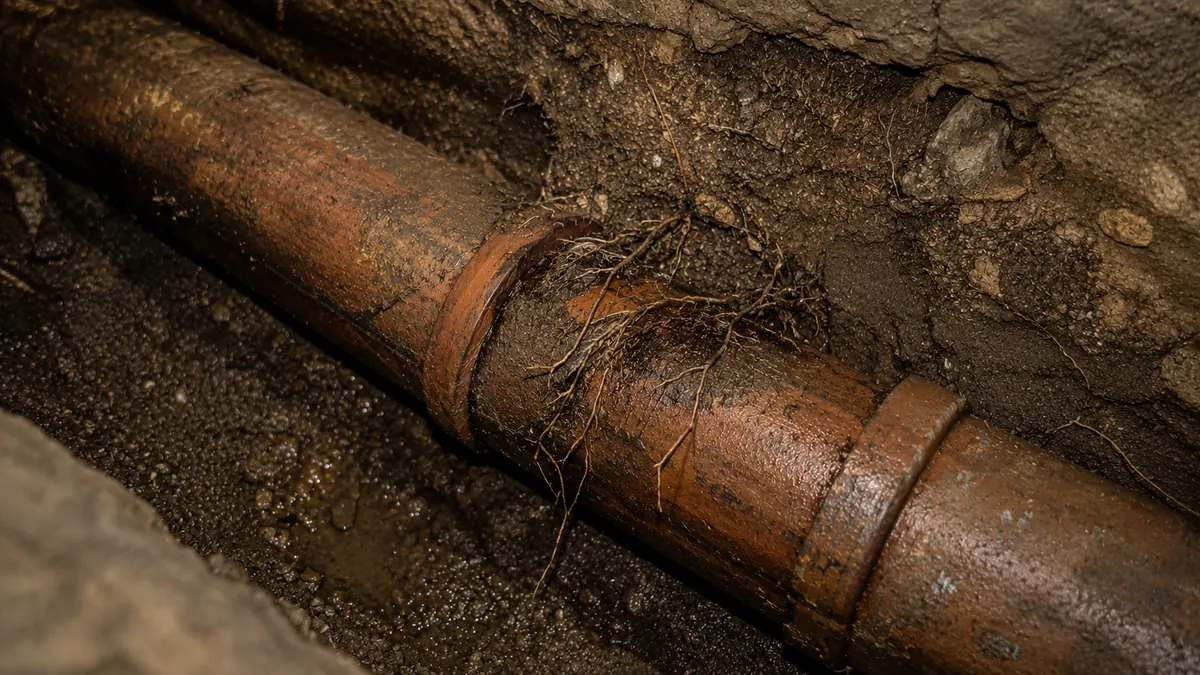
Vitrified clay tile in detail
Vitrified clay tile (VCT) is the dominant pre-WWII lateral material across Minnesota's urban core. It is fired terracotta — chemically inert, immune to corrosion, and indifferent to soil chemistry. In a sealed environment, a clay lateral could plausibly run for two centuries.
The Achilles heel is the joint. Clay tile is supplied in 24-inch sections and field-joined with cement mortar. Mortar is not flexible. Minnesota's seasonal soil flex of 4–6 inches at lateral depth opens hairline gaps at the joints every winter. By year forty, those gaps are wide enough for silver maple, American elm, green ash, and Norway maple feeder roots to find them. Roots follow the warm, nutrient-rich moisture plume out of the joint, hit jackpot, and proliferate.
Telltale clay-tile findings in MN scopes
- RFL / RFM / RFB: NASSCO codes for root fine light/medium/ball — always at a joint
- JOM / JOL: joint offset medium/large from soil shift
- CC: crack circumferential, often at joints with offset
- BHM: broken hub medium — the female end of a clay joint missing a chunk
- DAR: deposit attached rocks — backfill that found its way through a broken joint
Across 2,400+ Minnesota clay-tile laterals scoped since 2019, 71% had at least one NASSCO root finding by the time the home reached its 60th birthday. By year 80, that number is 94%.
SewerScopeMN Internal Defect Index, Q1 2026PVC SDR-35 in detail
PVC for buried sanitary sewer arrived in Minnesota residential construction around 1970 and became standard practice by the mid-1980s. The material itself is excellent — smooth, light, corrosion-proof, and supplied in 10 to 14 foot lengths with integral bell ends.
Two failure populations:
Early PVC (1970–1990)
Early PVC used elastomeric ring gaskets in the bell joints. Those gaskets are now 35–55 years old and have begun to harden, crack, or extrude. Symptoms on camera: dark joint shadow, fine root hairs at a single joint, mild infiltration staining.
Modern PVC (1990–present)
Modern PVC rarely fails as a material. When it fails, it is almost always installer error: a backfill rock pressing the side of the pipe, settlement at a deep crossing where backfill wasn't compacted, or a landscaping installer who drove a fence post or patio paver through the pipe years after the build.
How to identify each material on camera
Within the first 8–10 feet of a scope, an experienced inspector can identify the lateral material with high confidence:
- Orange-brown terracotta + joint every 24 in. → vitrified clay tile
- Bright white smooth + joint every 10–14 ft → modern PVC
- Pale green smooth + joint every 10–14 ft → early PVC (often SDR-35 with green tint)
- Dark grey/black with heavy scaling → cast iron
- Oval cross-section with delaminating walls → Orangeburg (see our pipe materials guide)
A common surprise in MN is a transition lateral — clay tile from the house out 15–25 ft, then PVC the rest of the way to the city main, the result of a partial replacement somewhere in the 1990s. Both materials are then in play, and both must be evaluated separately.
Repair class & what your options actually are
SewerScopeMN does not perform repairs. We flag findings by repair class so your contractor — or your buyer's agent during negotiation — has a defensible starting point. For more detail on repair methods see our hydro-jetting vs trenchless guide.
- Class 1 (maintenance): root cut + descaling, $250–$650
- Class 2 (point repair): single joint excavation, $1,800–$4,500
- Class 3 (spot replacement): 6–15 ft section, $3,500–$8,500
- Class 4 (trenchless CIPP lining): full lateral, $6,500–$14,000
- Class 5 (full traditional dig): full lateral excavation, $9,500–$22,000
See our full MN repair cost dataset for verified ranges.
Frequently asked questions
How long does clay tile sewer pipe last in Minnesota?
Vitrified clay tile has a 60 to 100 year service life if undisturbed, but root intrusion at the mortared joints typically becomes a recurring problem after 40 to 50 years in Minnesota, where mature tree canopies and freeze-thaw cycling accelerate joint separation.
How long does PVC sewer pipe last?
Modern PVC SDR-35 sewer pipe is rated for 100+ years. Early PVC installed between 1970 and 1990 has gasketed bell joints whose elastomeric seals are now degrading and beginning to leak or admit fine roots.
How do you tell clay from PVC on a sewer scope?
Clay tile has an orange-brown terracotta interior with visible joint rings every 2 feet. PVC has a smooth bright-white interior with bell joints every 10 to 14 feet. The transition between materials is usually visible at the foundation wall or city tap.
Which Minnesota cities still have clay sewer laterals?
Most homes built before 1965 in Minneapolis, St. Paul, Duluth, Stillwater, Winona, Red Wing, Mankato, and Rochester have vitrified clay tile laterals. Inner-ring suburbs like Edina, St. Louis Park, Richfield, and Roseville also have heavy clay tile inventory.
Is PVC always better than clay?
From a maintenance standpoint, yes — PVC has fewer joints, no root-attracting mortar, and a smoother interior that resists scale. But clay tile in good condition with no root pressure can outlast many newer materials.
Can clay tile be repaired without full replacement?
Yes. Trenchless cured-in-place pipe (CIPP) lining and spot point repairs are both viable for clay tile that retains structural shape. We do not perform repairs ourselves but our reports flag candidates with repair-class guidance.