What FOG actually is
FOG stands for fats, oils, and grease — the cooking byproducts that get poured down the kitchen sink, the dishwasher discharge soap residue, and the bacon grease that "should have gone in the can." Liquid going down a 100°F dishwasher rinse cools as it travels the lateral. By the time the wastewater reaches the colder ground temperature 30 to 60 feet from the house — about 45°F year-round in MN soil — the FOG separates out and adheres to the pipe wall. Years of this build into a hardened off-white to brown cap, often most severe at horizontal runs and joints where flow slows.
On-camera signs and severity grading
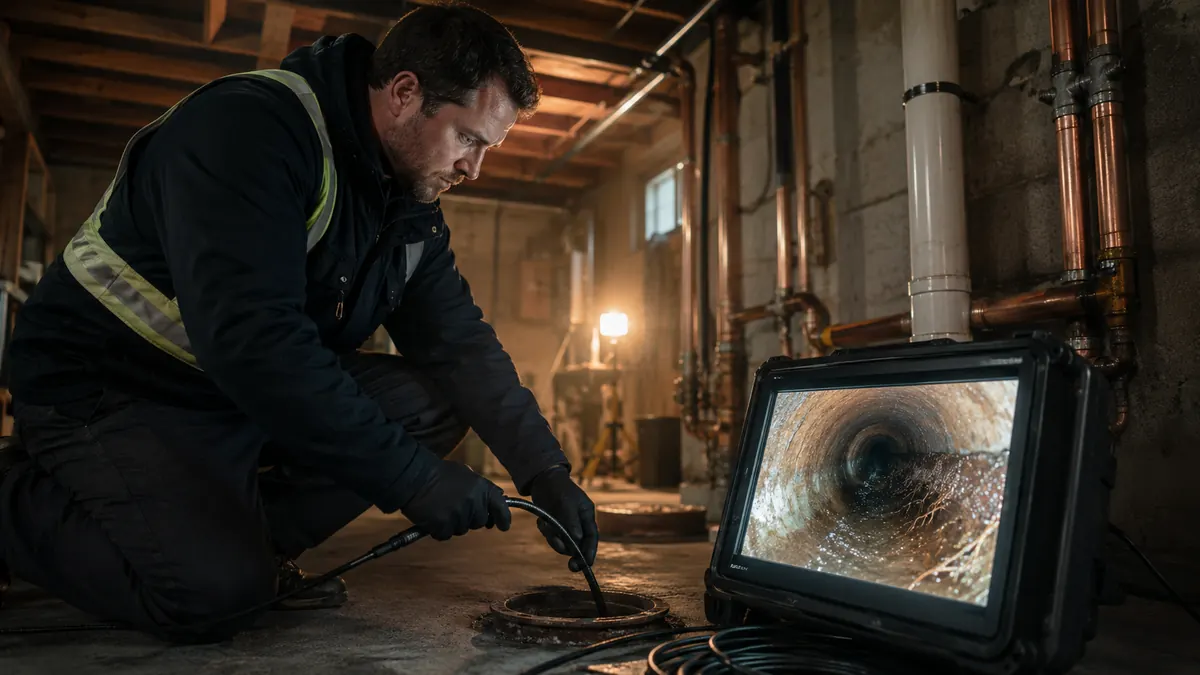
FOG appears on a scope as a waxy off-white or yellowish coating on the pipe wall, often most visible just past the foundation cleanout where flow first cools. Severe cases form a "grease cap" — a thick ring choking the pipe from the top down. Coding is by percentage of cross-section reduction:
| Severity | Restriction | Visual | Action |
|---|---|---|---|
| LOW (FOG-1) | < 10% | Thin waxy film | Enzyme maintenance |
| MEDIUM (FOG-2) | 10 – 30% | Visible coating | Hydro jet |
| HIGH (FOG-3) | 30 – 60% | Cap forming, top & sides | Jet now, re-scope |
| CRITICAL (FOG-4) | > 60% | Near-total obstruction | Multi-pass jetting |
Across 5,113+ Minnesota inspections we have documented, FOG accounts for 27% of all "flow restriction" findings — and is the only one that homeowners can eliminate entirely through behavior change.
Removal — what actually works
- Hydro jetting. A high-pressure water jet (3,000–4,000 psi) cuts the grease cap from the pipe wall and flushes it downstream. The only mechanical method we recommend for hardened FOG.
- Mechanical snaking. Punches a hole through the cap but does not remove the surrounding grease. The blockage often re-forms within months. Use only as an emergency clearance.
- Hot-water + enzyme follow-up. Bio-Clean or Roebic enzyme treatments, applied weekly for the first month after jetting, prevent re-formation.
- What does NOT work: Pouring boiling water alone, baking soda + vinegar, caustic chemical drain openers (Drano, Liquid-Plumr) — these can damage older pipe materials and barely affect a hardened FOG cap.
Prevention — five habits that keep your lateral clear
- Scrape pans into the trash, not the sink. The single biggest behavior change.
- Wipe greasy pans with paper towels before washing. Removes 80% of residual FOG before it ever hits water.
- Pour cooking oil and bacon grease into a sealable container, then trash. Never down the drain — even with hot water and soap.
- Run cold water with the disposal, not hot. Cold water solidifies remaining fats so the disposal can chop them rather than emulsifying them down the line.
- Use enzyme treatments monthly. $15 a bottle, takes 30 seconds to pour, dramatically extends time between jettings.
Cost ranges (Twin Cities 2026)
| Service | Typical Cost |
|---|---|
| Standard hydro jetting | $350 – $700 |
| Multi-pass jetting (FOG-4) | $700 – $1,200 |
| Mechanical snake (emergency) | $225 – $450 |
| Re-scope after jetting | $200 – $300 |
| Enzyme treatment (annual) | $25 – $80 |
Frequently Asked Questions
What is FOG in a sewer line?
FOG stands for fats, oils, and grease. When poured down kitchen drains, FOG cools and solidifies inside sewer lines, building up over months and years into hardened deposits that restrict flow and trap solids.
How do I know if I have a grease blockage in my sewer?
Symptoms include a slow kitchen sink, gurgling drains after running the dishwasher, recurring blockages near the kitchen wall, and sewer odors near the cleanout. A scope will show a white-yellow waxy coating on the pipe walls.
Can I dissolve grease with hot water and dish soap?
No. Hot water temporarily melts the surface but the grease re-solidifies further down the lateral. Dish soap emulsifies grease at the sink but does not penetrate hardened deposits. Hydro jetting is the only reliable removal method.
How often should a homeowner hydro jet their sewer line?
For a home with high cooking frequency or known FOG buildup, hydro jetting every 24–36 months is a reasonable maintenance schedule. Homes with negligible kitchen output may go 5–10 years between jettings.
Are enzyme drain treatments effective on grease?
Enzyme treatments like Bio-Clean help maintain a lateral that has already been jetted clear. They are not a substitute for mechanical removal of an existing FOG cap.
How much does grease-blockage clearing cost in the Twin Cities?
Hydro jetting for grease removal runs $350–$700 typically. A re-scope to confirm clearance adds $200–$300. Severe long-standing FOG caps may require multiple jetting passes and run $700–$1,200.