Why Minnesota built with vitrified clay tile
From roughly 1900 through 1965, vitrified clay tile (VCT) was the default residential sewer lateral material across Minneapolis, St. Paul, Duluth, Rochester, and every historic small town in between. Clay was cheap, locally produced, corrosion-immune, and — on paper — capable of a 60+ year service life. The catch is in the joints.
Clay tile is manufactured in two-foot sections, each section joined to the next with a hand-packed mortar collar. That mortar interface is where every clay lateral eventually fails. Mortar is porous, brittle, and chemically attacked by both the wastewater inside and the groundwater outside. Add 100+ Minnesota freeze-thaw cycles per decade, and the joints loosen on a predictable timeline.
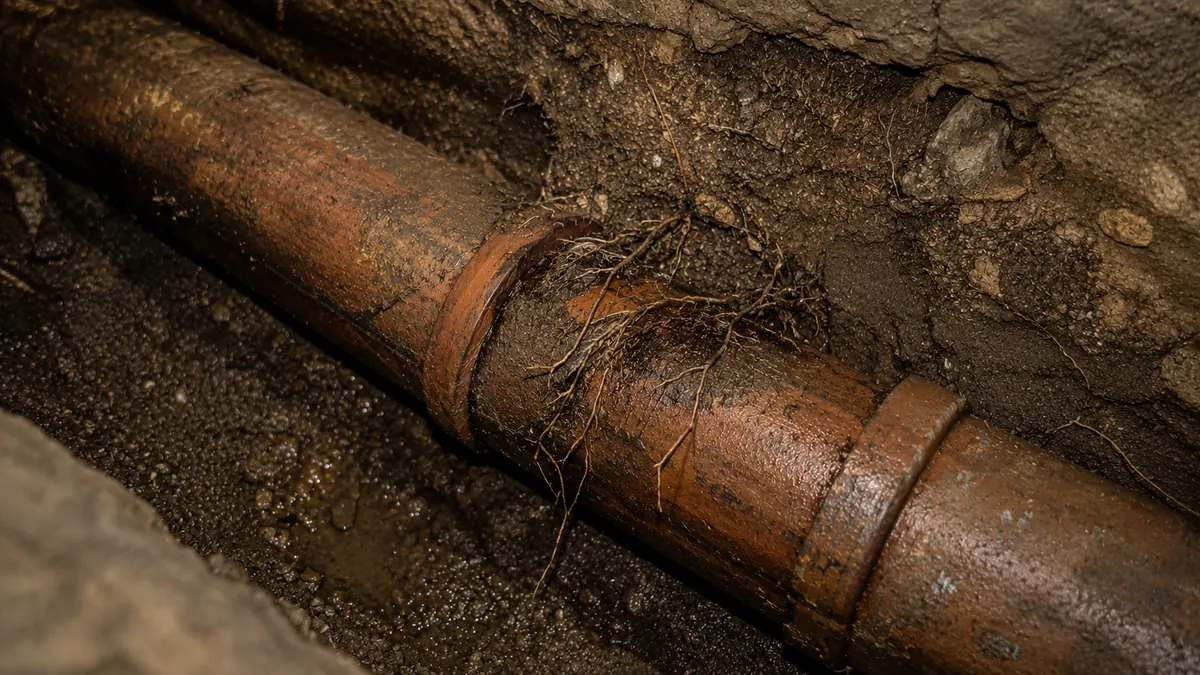
How clay fails in Minnesota
Root intrusion at joints
The dominant failure mode. A mortar gap of even half a millimeter is enough for a hair-thin root to enter; once inside, the root expands annually, eventually forming a dense mass that captures debris and chokes flow.
Joint offset from frost heave
Minnesota's deep frost penetration causes annual soil movement around the trench. Over decades, individual clay sections shift relative to their neighbors. We routinely document offsets of half an inch or more in homes from the 1920s and 1930s.
Circumferential cracking
Soil load combined with seasonal freeze pressure produces ring cracks. Once present, they propagate quickly during subsequent winters.
Bellies (sags)
Clay sections are heavy and rigid. When bedding soil washes out beneath them — often the consequence of years of slow exfiltration through a joint — the line sags into a low spot where waste settles and roots thrive.
What clay tile looks like on camera
An unmistakable orange-brown terracotta interior, often glazed slightly on the inside, with visible mortar collars every 24 inches. Healthy clay is dry, smooth, and free of intrusions. Compromised clay shows a predictable sequence: first fine root hairs at the joint crown, then ribbon roots filling the joint gap, then a "root mass" that occupies 30%+ of the cross section, then circumferential cracks just upstream of the most clogged joint.
Across 5,113+ MN inspections we've documented, vitrified clay laterals from before 1965 show at least minor root intrusion on 71% of properties — and clinically significant root intrusion on 29%.
Repair options for failing clay
| Option | When to use | Notes |
|---|---|---|
| Mechanical root cutting | Pure root, no structural damage | Annual or bi-annual maintenance |
| Hydro-jetting | Light root and scale | Don't use on cracked clay |
| Trenchless lining (CIPP) | Multiple defects, line intact | Restores 50+ year life |
| Pipe bursting | Severe damage, line not lineable | Pulls new HDPE through old path |
| Open trench replacement | Collapse, severe sag, shallow line | Highest cost, fully resets life |
Should I replace clay proactively?
If your clay is dry, joints are tight, and there are no roots — no. Clay that has survived this long without major intrusion is likely to keep going. If you have multiple compromised joints, sags, or any circumferential cracking, the math usually favors a CIPP liner now over a full collapse later.
Frequently Asked Questions
How long does clay sewer pipe last in Minnesota?
Design life is 60+ years; many MN clay laterals are pushing 90 and still functional. The pipe material itself is durable; the joints are the limiting factor.
Can you reuse clay pipe with a liner?
Yes. CIPP (cured-in-place pipe) lining bonds an epoxy-saturated felt sleeve to the inside of the host clay, sealing every joint and crack and restoring decades of life.
Are clay sewer pipes safe?
Yes — clay is chemically inert and does not leach. The risks come from joint failures (root intrusion, exfiltration), not the pipe material itself.
How do I know if I have clay?
Construction-era hints: any MN home built before 1965 is a high probability for clay. The only definitive answer is a scope.
Does insurance cover clay pipe replacement?
Generally no for age-related failure. Some MN insurers offer sewer-line riders that cover collapse from specified events.